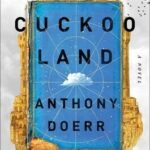
Cloud Cuckoo Land by Anthony Doerr didn’t click for me until I was already more than 80% of the way through the book. Up to that point, I had enjoyed it, but I didn’t quite know where the book was leading. Told in anachronic order, the novel weaves together the stories of five characters over hundreds of years, and while each of these stories revolve around that character’s connection to an ancient Greek text called Cloud Cuckoo Land, there’s no specific plot point that each is building up to in unison.
A story within a story, Cloud Cuckoo Land is about a text called the same by Antonious Diogenes, a first century Greek writer. But while Diogenes was real, the work is an invention by Doerr. It’s clear though that he took inspiration from an actual work by Diogenes called “The Wonders Beyond Thule,” which refers to lands beyond Scandinavia. Unfortunately, that work has been lost, and all that remains is a short summary by a Byzantine monk written in the ninth century. Working from that small snippet, Doerr reconstructs a possible substitution for the lost work, turning Cloud Cuckoo Land into an imaginary story about a shepherd who undertakes a magical journey across all the lands of the Earth and the stars of the sky.
That theme of lost works and how the written word can connect us across time is a constant one throughout the novel as each character does their own part in preserving the text. Anna, living in Constantinople just before the conquest by the Ottomans in 1453, discovers it in the tower of an abandoned monastery. Eventually, her path crosses with Omeir, a Turk living in modern-day Bulgaria. They marry, and after Anna dies, he takes the book to a library in Italy to be preserved for future generations. It is re-discovered in 2019, and Zeno works to translate it — a job that is finished by Seymour. In the future, Konstance finds the work while aboard the Argos, which is a generational starship en route to another world after Earth has been wracked by climate change.
Throughout each character’s story, the impact of the ancient text leaves a clear impression as their fates are intertwined in ways that none of them can see. Had Anna not found the text, Konstance, living hundreds of years later, may have never found a dark truth about the starship she is living in. Both Zeno and Seymour may have never found redemption, and Omeir may have died a lonely man. Their actions connect them together, and the written word gives their lives meaning.
All of this is clear roughly a third of the way through the book, but like I said, it didn’t click for me until I was more than 80% of the way through. At that point in the book, I had laid it down to grab a glass of water, but on my way to do so, I passed a bookshelf. Amongst the various books I have read and those I want to read, there’s a few older ones given to me by my grandfather and my father, both of whom are now passed. I picked out those books for the first time since I put them there: Foundation by Isaac Asimov, Annie Was A Lady by Dakie Caldwell Cowan (a biographical work about a related family member), The Once and Future King by TH White, and Myths of Greece and Rome, a tattered book printed in 1893 and owned by various family members. The last one contains a number of doodles in its opening pages, including of World War II era fighter planes and bombs dropping on crudely drawn buildings. But it also contained a note from my grandfather, written in 1997, asking me to take good care of it.